
How much does land clearing cost per acre in Florida?
National cost guides put land clearing at about $500 to $8,000 an acre. Light brush sits near the bottom of that range. Heavy pine and oak woods sit near the top. One guide puts the average Florida clearing job at $3,890 in 2026.
These are published market numbers, not our price list. Two things move a Florida acre across the range: what grows on it and where the debris goes. Wet ground and access come after that.
What does an acre cost to clear by the kind of growth?
One national cost guide breaks out an acre this way:
| Kind of growth | Cost per acre | What the guide counts in it |
|---|---|---|
| Light clearing | $1,200 to $2,500 | Shrubs and small trees |
| Moderate clearing | $2,500 to $4,500 | Thicker underbrush and medium trees |
| Heavy clearing | $4,500 to $8,000 | Thick underbrush and large trees |
| Brush removal | $800 to $3,000 | Brush only |
| Forestry mulching | $500 to $1,000 and up | Growth ground into mulch where it stands |
A second guide prices lightly wooded ground at $733 to $2,333 an acre. It puts heavily wooded ground at $3,395 to $6,155. A third puts most single acres at $500 to $5,600.
A home services directory lists Florida lot clearing at $1,223 to $2,498 an acre. That report does not say when its numbers were gathered.
None of these guides gives palmetto its own line. We read a palmetto flat under scattered slash pine as closest to the moderate row. Big live oaks push a lot toward the heavy row. One guide notes that hardwoods like oak take longer to cut and remove than pine.
We price land clearing in Melbourne and across Brevard County by looking at the lot first. Use the table to plan, then get a number for your own ground.
Why do palmetto flats and wet ground raise the price?
Saw palmetto looks low and easy to cut. A U.S. Forest Service plant review says its stems run along the soil surface and branch into rhizomes. The plant sprouts back from those stems and rhizomes. The same review says uprooting the stems and rhizomes controls it.
So a palmetto flat can take more work than its height suggests. Mowing the fronds leaves the rhizomes in the ground. A building pad needs them out.
Myakka soils cover about 1.4 million acres of peninsular Florida, mostly in the flatwoods. Their native cover includes slash pine with an undergrowth of saw palmetto. The NRCS soil survey rates them poorly or very poorly drained.
In most years their water table sits within 18 inches of the surface for 1 to 4 months. Wet ground slows the work. One cost guide notes that rain can delay a job and make a site unsafe for heavy equipment. Some clearing is billed by the hour, and another guide lists $110 to $250 an hour.
The National Weather Service office in Melbourne puts the median start of the wet season at May 28. The dry season starts around October 17. One guide suggests clearing in winter, when equipment can run on solid ground.
Does hauling debris off cost more than mulching it in place?
Per acre, mulching sits lower in the cost guides. One guide puts forestry mulching at $500 to $1,000 and up an acre. Another gives about $400 an acre on average, or $150 to $250 an hour. Nothing gets hauled, so the debris line drops off the bill.
The trade is what stays behind. Mulching grinds the growth where it stands, and the roots stay in the ground. One guide says mulching suits trails and pasture upkeep, but not building sites. Our forestry mulching with the disc mulcher fits fence lines and brush where the mulch can stay.
A house pad is different. Trees and stumps come out with the roots, and the pile has to go somewhere.
Hauling the debris off adds truck trips and dumping fees. One guide lists dumping fees among the local costs that move a price. Some contractors fold disposal into the base price, and others charge it apart. We can bundle debris removal into the same quote as the clearing.
One guide lists burning as a third route where local rules allow it. In Florida, land clearing pile burns need an authorization from the Florida Forest Service.
What else moves the price on a Florida lot?
Bigger tracts cost more in total and less per acre. One guide puts a quarter acre at $800 to $3,000 and five acres at $4,500 to $35,000. The guide says machines work more efficiently across more acres once they are on site.
Access matters too. A lot with direct road access costs less to clear than one that needs a temporary road first.
Stumps add their own line. One guide lists stump removal at $100 to $150 a stump. Another averages $326 for the first stump and $40 to $83 for each one after. That guide says a construction site is best with the whole stump and root system out.
Permits bring their own costs. One guide puts an average land clearing permit at $200 and notes that rules vary by county. In unincorporated Brevard County, the permit application asks for a boundary survey and a survey of protected trees. One guide puts a land survey at $500 to $1,500 and up.
Gopher tortoises can change the schedule. The Florida Fish and Wildlife Conservation Commission requires a relocation permit before clearing within 25 feet of a burrow. That step comes before any machine starts. Our guide to Brevard County land clearing permits covers the offices and the order of steps.
How does a written quote for your lot work?
We look at the lot before we put a number on it. The quote spells out what stays and what goes. It also says where the debris ends up. You get a free quote in writing.
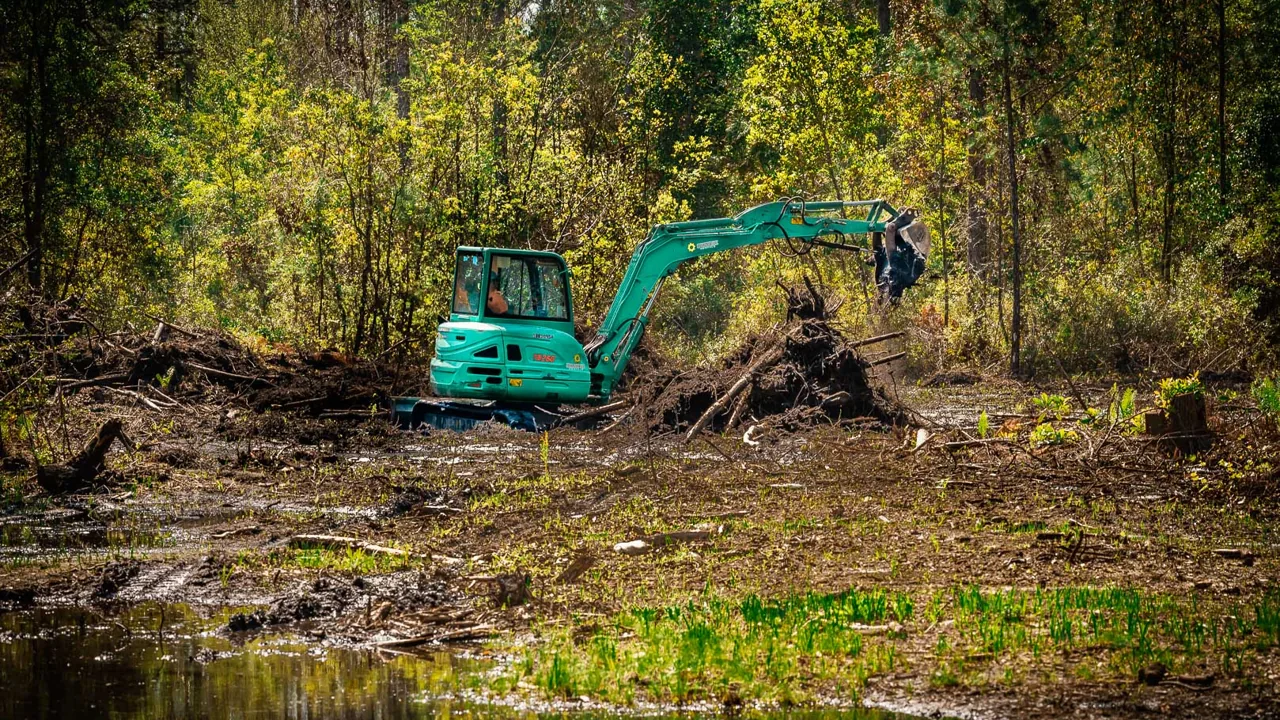
Our skid steer runs a disc mulcher for brush and small trees. The tree puller lifts trees and stumps out, roots and all. For larger trees and dirt work, we bring in a rented excavator. One quote can mix methods across the same lot.
See how we clear lots and acreage around Melbourne. Call or text (904) 719-0443 to set up a look at your land.