Forestry Mulching or Bush Hogging: Which Does Your Florida Lot Need?
Bush hogging cuts overgrowth down low and leaves the cut pieces lying on the ground. Forestry mulching grinds brush and small trees where they stand into a layer of mulch. Pick the mower for grass, weeds, palmetto and saplings you want knocked back fast. Pick the mulcher for thick brush and small trees you want ground up and spread as mulch.
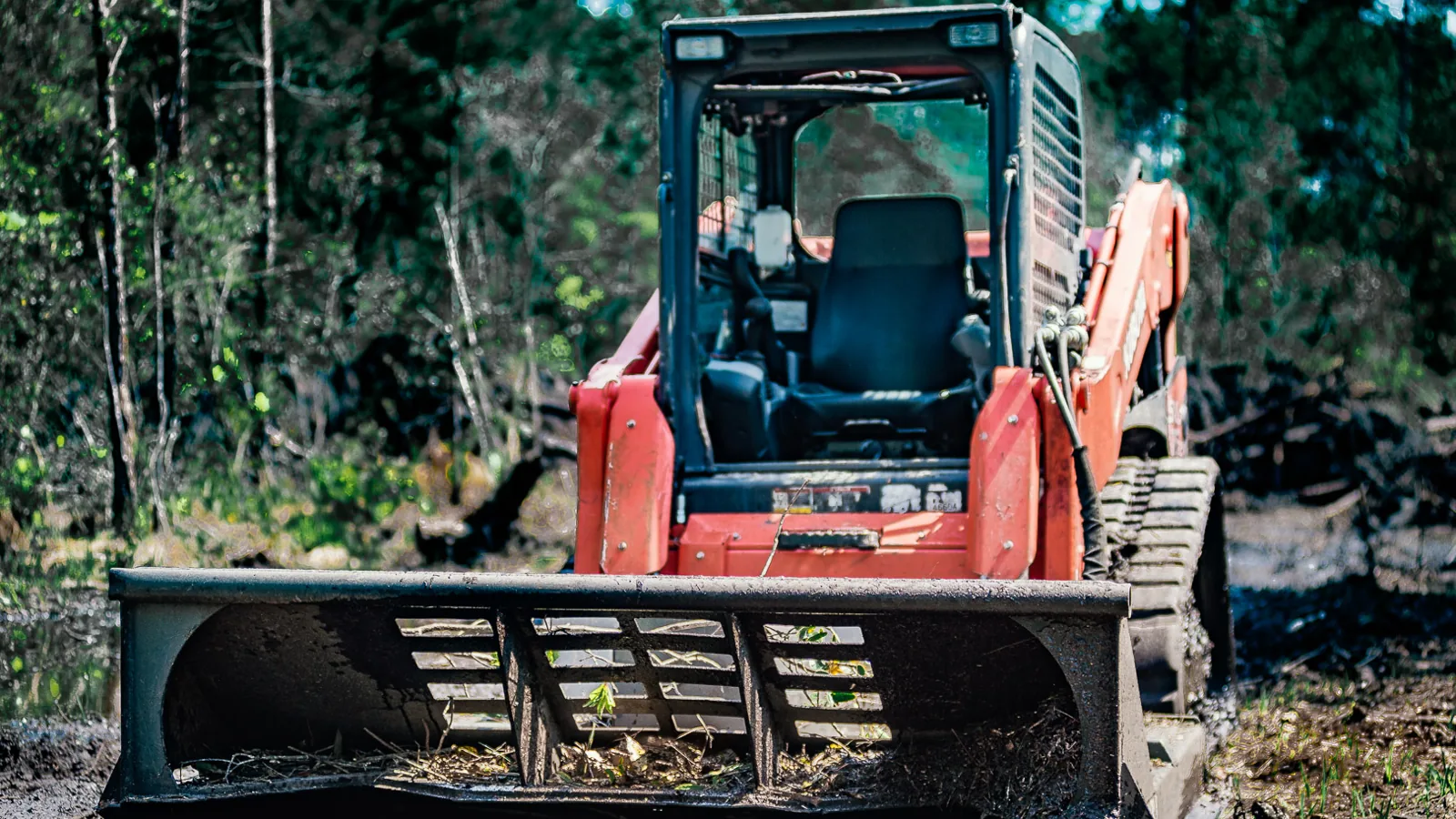
At BW Clearing, we run both as attachments on our skid steer. The disc mulcher handles our forestry mulching, and a hydraulic three-blade brush mower does the bush hogging. Many overgrown lots need some of each.
What is the difference between forestry mulching and bush hogging?
A bush hog is a rotary mower. The University of Florida extension service describes heavy blades that spin flat and cut plants at the base. Ours is a hydraulic three-blade brush mower on the skid steer, and it covers ground faster than the mulcher. It does our brush mowing and bush hogging on overgrown lots and pasture.
Forestry mulching uses a spinning head lined with cutting teeth. Ours is a disc mulcher, with bladed teeth on a flat disc. It cuts brush and smaller-diameter trees and grinds them into mulch where they stand. Everything it cuts stays on the lot as a mulch layer.
| What to compare | Our brush mower (bush hogging) | Our disc mulcher (forestry mulching) |
|---|---|---|
| What it leaves | Cut stems and stubble on the ground | A layer of coarse mulch over the ground |
| Stumps and roots | Roots stay, and cut saplings leave short stumps | Roots stay, and short stumps stay visible |
| Growth it suits | Grass, weeds, palmetto, brush and small trees up to about 5 inches | Thick brush and smaller-diameter trees |
| Good for | Overgrown lots and pasture upkeep | Selective clearing, trails, fence lines and thickets |
| Speed | The faster of the two | Slower, and finer mulch takes extra passes |
| How long the cut lasts | About a year, per the extension service | About a year, per the extension service |
What does each one leave behind?
After the mower, the lot is cut low. Shredded stems and leaves lie on top, and the roots stay put.
After the mulcher, a layer of chips and shredded brush covers the ground. A national cost guide says disc mulchers work faster than drum mulchers. The trade-off is coarser mulch, and the stumps stay visible. That mulch breaks down over time.
Neither machine pulls roots, and that matters when a house or a barn comes next. One national cost guide says mulching is not suitable for a building site. For a build, the tree puller lifts stumps out roots and all, and an excavator levels the ground. That is land clearing around Melbourne, a bigger job than mowing or mulching.
How big a tree can each machine take down?
The extension service draws a general line. Mowing works on soft plants and woody stems under 3 inches thick. Mulching handles much bigger woody plants.
Machines vary. Our hydraulic three-blade mower cuts dense brush and small trees up to about 5 inches. Our disc mulcher is built for thick brush and smaller-diameter trees.
Overgrown lots around Melbourne often hold saw palmetto and young slash pine, with Brazilian pepper along the edges. Both machines take palmetto and brush down.
Trees you want gone, roots and all, come out another way. The tree puller grips a tree in its jaws and lifts it out of the ground. The biggest trees and stumps go to an excavator.
Will the overgrowth grow back after mowing or mulching?
Yes. Both methods leave the roots in the ground, so growth comes back. A University of Florida extension guide compares ways to knock back brush in Florida woods. It rates the effect of mowing and mulching as “very short (around 1 year).”
Cut trees come back fast too. The extension service warns that trees cut off at the ground resprout quickly when nothing else is done. Brazilian pepper is one of the weedy trees it names along fence rows.
When a tree or a thicket should not come back, the tree puller pulls it out by the roots. With the roots out, nothing grows back from the stump.
What does forestry mulching cost compared with bush hogging?
On open ground, bush hogging costs far less per acre than forestry mulching in national figures. The mower covers ground faster and does less to each plant.
A pricing guide for lawn care pros puts a 6-foot cutter at about 2.4 to 3 acres an hour. That is on open pasture in perfect conditions, and real jobs often run slower. A national cost guide says a skid steer mulcher covers 1 to 3 acres a day.
| Work | Market range | Source |
|---|---|---|
| Forestry mulching, per hour | $125 to $300 | National cost guides |
| Forestry mulching, per acre | $400 to $800, up to $2,000 for dense growth | A national cost guide |
| Forestry mulching, per acre | $1,000 to $2,500 | A second national cost guide |
| Forestry mulching, minimum charge | $400 to $600 | A national cost guide |
| Bush hogging, per hour | $85 to $120 for a tractor and 6-foot cutter | A pricing guide for lawn care pros |
| Bush hogging, open pasture | About $100 per acre | The same pricing guide |
| Bush hogging, minimum charge | Often 2 to 3 hours | The same pricing guide |
These are national market numbers, not our price list. Every lot is different, so treat them as a rough guide.
Thick growth and bigger trees take longer, so they cost more. Mulching around trees you want to keep takes extra care and time. Finer mulch takes more passes, and each pass adds machine time. Tight access, such as a fence that has to come down, adds cost too.
Wet ground slows any machine and can add cost. Travel and minimum charges weigh most on small lots.
When does a lot need both?
A lot with open palmetto and a band of small trees is the common case. The mower cuts the open ground fast, and the mulcher works the tree line. The same split suits a lot headed for sale.
Upkeep is the other case. Mulch once to reset an overgrown lot, then mow the regrowth on a schedule. One national cost guide says most properties need follow-up mulching every one to three years.
Do mulching and mowing need a permit?
Sometimes, and the rules can treat them differently. In unincorporated Brevard County, the county code calls the cutting down of vegetation, trees included, land clearing. A permit is required before land clearing unless the code exempts the job. Allowable mowing that keeps vegetation healthy is not land clearing under that code.
Cities write their own rules, so ask the county or city office before the machines run. Our guide to Brevard County land clearing permits covers the offices and what they ask for.
Which one does your lot need?
Call or text (904) 719-0443 with the size of the lot and what grows on it. Tell us what comes next, too: a sale, a build, a pasture or plain upkeep.
We look at the lot and tell you which machine fits, or whether it takes both. Then we put the quote in writing. See how our forestry mulching service clears brush and small trees.